Sunday, April 30, 2006

Views on Muslims in The America

Dallas, Texas, April 2000

I am not an expert on this topic because I do not live in The America and I have not made it a point to research the views of Americans towards Muslims. I have, however, recently made a couple of observations that have troubled me.


The first observation has to do with the views of our own Anonymous A-hole. Asshole seems to lump all Muslims together into one group that can be defined as terrorists and supporters of terrorism. I give you as evidence his comments on my post of 23 April. Asshole, I know I don’t need to say this because you need no encouragement, but please correct me if I am wrong.

Then on Friday I spent the evening with friends of my parents whom I had never before met. They were interesting people and liked to drink and were really good fun, but certain comments that they made troubled me. They had just come from Paris where the Muslim presence is visible – darker-skinned people, hijabs, etc. They asked me if there were Muslims in Prague. I answered that there were, but not nearly so many as in Paris. Their comments then about Muslims in Paris, and Muslims in general, were all negative. In fact, worse than negative.

The fact that we were sitting in a synagogue while they made these comments was not lost on me. Go back in time 70 years and we could have been sitting in a church in Germany talking about Jews.

The couple I was with are contemporaries of my parents, well-educated, well-travelled, cultured, cosmopolitan professionals. The thought that troubles me is that if they are thinking that way about an entire group of people, what are the people in small towns in middle America thinking? Is this the current trend in America – to think of Muslims as bad people? As a liability to society because of their religious beliefs and their cultures?

I hope people in The America can tell me that I am wrong, that this couple from LA were an anomaly. But I have to ask, what ever happened to taking each person as an individual based on their own words and actions? What has happened to live and let live? Respecting other people’s religious beliefs? And innocent until proven guilty?

I am aware that multiculturalism is a bit of a myth, that while 100 cultures may be represented in a city like Paris, London or LA, people tend to stick to their own kind and not really mix that much. But to go that much further to cultivate thoughts and beliefs that entire groups of people are bad is sickeningly dangerous.

And having picked on The America, I should also say that some places in Europe are going in the same direction.

Next episode: serious Jew-bashing if (when) Iran is attacked, whether by Israel or the US – it won’t matter.

Saturday, April 29, 2006

On the night bus with Ludo

an Ústí trolleybus in the daytime

I was reminded of this story recently, which is surprising because I normally cannot recall things that happened 13 years ago.

Ludovic and I were out late one night in Ústí nad Labem and we had decided to take the night bus home rather than walk. It must have been a weekend because there were at least 20 other people waiting at the bus stop on the main square. The bus came on time, we all got on, and it seemed that Ludo and I would get home without misadventure.

But then the ticket inspectors got on and announced to the passengers that night buses were now more expensive than regular daytime buses, i.e. you had to have two bus tickets or a bus pass + a ticket. The ticket inspectors began checking all the people and, not surprisingly, no one had two tickets. The reason being that the inspectors’ announcement was the first anyone had heard of the new night bus premium.

I remember thinking in my naïve American way that when the inspectors realised that no one had known of the new two-ticket rule, that they would let us all go on our way with nothing more than a verbal warning and a reminder for next time. But, of course, that is not the way things work in the weird Czech world that I live in.

Next thing we knew, the bus pulled up at the police station and we were all herded inside. The thing I found the oddest was that none of the Czech passengers, i.e. everyone on the bus aside from me and Ludo, was arguing. They were going into the police station like sheep to the slaughter. There must have been about 30 people. Ludo didn’t want to argue either because he had already had several run-ins with police who thought he looked a bit too much like an illegal alien from Romania, and they never quite believed that his New Zealand passport had been issued by a real country.

Max, however, was slightly drunk, definitely belligerent and not in the mood to be treated like a criminal. I argued in what must have been slightly comedy Czech as I had not even been in the country for a year at the time and my language skills were still rather basic. My arguments, no matter how they sounded in Czech, were rational and logical. There had been no sign at the bus stop and no sign on the bus – how the hell were we to know that the night bus suddenly required two tickets? The ticket inspector I had accosted responded that it didn’t matter, that we knew now, and that we were all going to be processed and fined by the police. I said that was bullshit and that all they could do to us was inform us that we would need two tickets next time. I went on for a while longer than that, but you get the idea. The problem was that you cannot talk sense into people that have no sense.

The police and inspectors left us sitting there for a while and I told Ludo that I was going to leave. Ludo, always nervous and wary of trouble, argued with me and asked me to wait because there was no way he was going to walk out with me. But only a few minutes later, while I was fidgeting with impatience, a policeman came into the waiting area and told us we were all free to go. Ludo and I walked out and walked home.

We avoided the night buses for a while, but eventually we heard that the two-ticket requirement idea had been scrapped and it was safe to ride the night buses again armed with nothing more than a single ticket or a pass.

Thursday, April 27, 2006

Another Jail Story from the City of Kafka


This episode took place yesterday, it is all true, and it is brilliantly and hilariously recounted by my friend Patrick at Dog Eat Blog. Enjoy.

http://www.prague-spot.com/blog/article/232/robots-mo-prague-popo

Sunday, April 23, 2006

Max goes analytical

You may have guessed from my post of 31st March that I would be reading Moazzam Begg’s book, Enemy Combatant: A British Muslim’s Journey to Guantanamo and Back. A couple of days ago, I came upon this bit on page 155: “I hadn’t read Kafka, but I knew the expression Kafkaesque. It was happening to me.”

As synchronicity would have it, just four days earlier, I had been discussing Franz Kafka’s The Trial with the London book club of which I am an honorary member. They were in Prague for the weekend and so had chosen an in situ book. It suddenly struck me that Begg’s story was indeed a real life version of The Trial. There are obviously a lot of differences between the stories, including how they end, but the similarities are striking.


The Trial is the story of Josef K, who goes through very strange proceedings within a surreal court system without ever being told what it is he has been charged with. Begg went through “proceedings” (abduction, rendition, torture) that would have been unimaginable to us just a few years ago, also without ever being told what he had been accused of.


While I was looking for information that would add extra value to the book club meeting, I came upon a reference to Jean-Paul Sartre’s Anti-Semite and Jew: An Exploration of the Etiology of Hate. In this book, Sartre discusses the ordeal of the Jew born into a world where anti-Semitism flourishes. Sartre presents the argument that this was Josef K’s world, and perhaps Kafka’s world too. It was an angle I had not thought of, especially because neither religion nor ethnic background is mentioned in The Trial, and because I had never perceived any of Kafka’s work as having particularly Jewish themes. I had, however, thought of The Trial as a possible metaphor for life, i.e. while everything seems to be going along well, one suddenly loses control, realises he has no idea what is going on or what it is all about, and then can do nothing more than grasp at straws to try to get through the trial that is life.


Sartre:
This is perhaps one of the meanings of The Trial by the Jew, Kafka. Like the hero of that novel, the Jew is engaged in a long trial. He does not know his judges, scarcely even his lawyers; he does not know what he is charged with, yet he knows that he is considered guilty; judgment is continually put off -- for a week, two weeks -- he takes advantage of these delays to improve his position in a thousand ways, but every precaution taken at random pushes him a little deeper into guilt. His external situation may appear brilliant, but the interminable trial invisibly wastes him away, and it happens sometimes, as in the novel, that men seize him, carry him off on the pretence that he has lost his case, and murder him in some vague area of the suburbs.


Upon pondering them all together - Kafka, Sartre and Begg - I have come to the conclusion that the Muslim now shares the position of the Jew in the western world. That is, while he is supposedly assimilated (to varying degrees), he is also often irrationally disliked, distrusted or hated, although he may be doing nothing more than trying to get through life like his counterparts of any other religion, ethnicity or nationality. No matter what he does or how he lives his life, he will always be guilty by virtue of who he is.


What a lovely world we live in.


Thursday, April 20, 2006

No comment necessary


Thanks for sending the photograph, Jimmy.

An answer perhaps still in progress

I get the questions all the time:
What brought you to Prague? Why Prague?
And then – Why have you stayed?
Accompanied by - Don’t you miss your family? Don’t you ever want to go home?

The first pair of questions is easily dispensed with for they are questions of fact. Peace Corps sent me to Czechoslovakia and after my two years in Ústí nad Labem, I decided to move to Prague because I liked it.

The last questions, the afterthoughts, are also simple. No, in fact, I don’t really miss my family. I love them, I visit them, but they have their lives and I have mine. And, I’m sorry, what do you mean by home? I am at home here and no, I don’t see myself returning to the US.

And then the ‘why have you stayed?’ question becomes more philosophical. My answer has changed over the years, but I think I have finally now hit on the right one, although it is never easy to explain.

The answer is that I am more free here. It is not freedom in the sense that I can roll a spliff and smoke dope on the street without fear of arrest, or freedom in the sense that there are no licensing hours and I can find an open bar round the clock, though those are things that I appreciate. It is the deeper personal freedom that makes my life here more appealing.

My friends with whom I grew up, and my sisters, are mostly married with children, they own homes and have careers that are important to them, or their own businesses. If I had stayed in the US, these are the things that would have been expected of me, and I would have suffered from the weight of the expectations.

Most of my close friends here in Prague are also expatriates. It is not because of the language or the similarities in how we grew up. As an example, one of my friends grew up in East Germany. It is that we have more in common because we live in a country that is not our own and we have all escaped the weight of the expectations.

I am not talking about professionals who have been sent here by their corporations for a few years or backpackers who settle in to teach English for a year or two, I am talking about those of us who have stayed on and have no plans to leave. Some of my ex-pat friends, even a couple of former Peace Corps volunteers, do own homes and are married and have children here. I am not talking about them either, because their raison d’être has metamorphosed into something else.

I am considered mainstream by some of my friends because I have a real job in which I can take sick days and I get paid holidays. It has not always been like that for me. I am glad that it is like that for me now because I hate to have to worry about making my rent, but sometimes I resent having to spend 40 hours every week in an office.

I can say that I am a lawyer, but I am not yet qualified to practice anywhere. If I were still in England, I would be a trainee solicitor, and I think I would hate it. My job is different here, and it now looks like I am on an accidental path to qualifying as a Czech advocate; the title of European advocate will follow that. Or I can just continue doing what I am doing – writing, editing and marketing, and no one around me will ask me condescendingly why I am wasting my time and talents by not qualifying. No one cares, as long as I am satisfied.

kd teaches English, Mike works in a bar between acting jobs, Sunshine drives an airport taxi, I still haven’t figured out what some of my other friends do for a living. No one cares, we don’t judge each other on that.

Jono was over here from London last weekend. We were talking about his impending purchase of a flat there. Finally, he asked me, “Will you ever consider buying a flat in Prague?” When I answered no, that I was not interested in owning property, he smiled, relieved, and said, “I don’t know what I would do if you suddenly wanted to do something as normal and mundane as that.”

At Easter dinner, an older friend of AG’s was quizzing me on why I didn’t want to have children. That answer could, of course, be another entire essay, but it too would come round to the freedom thing.

A lot of Czechs who are living a ‘normal’ life in their own country think that ex-pats as a group are mad as a box of frogs, but that also works to our advantage – they have no expectations for us either.

Tuesday, April 18, 2006

Too Good to be True

MiniKiss on stage

Not only is there a Kiss tribute band made up of dwarves, which would be fantastic enough, but there are two of them - MiniKiss and Tiny Kiss.

The two bands are supposedly staging a battle over who owns the concept of a dwarf Kiss tribute band, but who cares. The fact that they exist makes my day.

Here is the MiniKiss website, which has loads of photos: http://www.littlemanentertainment.com/

And here is a link to a story with a great cover photo:
http://tinyurl.com/otqe5

And here is the story of the dwarf feud in the LA Times:
http://tinyurl.com/om4ll


Monday, April 17, 2006

Stop your whining

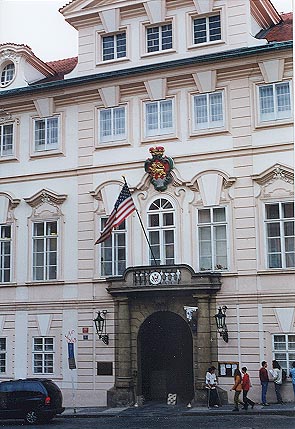
US Embassy in Prague

Over 350,000 American tourists come to the Czech Republic every year. But while citizens of the United States do not need a visa to visit the Czech lands, Czech citizens still need a visa to enter the United States.

One of the stated reasons is that a lot of Czechs stay and work illegally in the US. By requiring Czechs to go to the US embassy in Prague for interviews before they can obtain a visa, US officials try to weed out those whom they suspect might not return to Czech when their allotted time as a visitor (usually up to 6 months) has run out.


The process is fairly simple although it can be a hassle, especially for those who live far from Prague. You download the application form from the internet, fill it in and fax it back to the embassy. You ring the visa office the next day and schedule an interview. Before your interview, you must pay the fees – CZK 2500 processing fee + CZK 185 for the return courier service – which you can do by bank transfer or at the post office or any branch of ČSOB bank. On the day of your interview at the embassy, you bring your completed application form with a photograph, receipts showing you have paid the fees and a few other things, depending on your situation (e.g. bank statements, proof of employment, etc). If you get the visa, your passport is returned to you later by courier. If you are refused a visa, you leave with your passport and can write to the courier company to have their fee returned to you.


The US State Department has said that when the visa rejection rate has been at 3% or less for two consecutive years, then the Czech Republic can become part of the visa waiver programme. The official rejection number coming out of the embassy is currently at 10%. One of my Czech friends said that she heard 30% on Czech television, but I would tend to believe the embassy in this case.


And the Czechs whine. It’s not fair because US citizens don’t need visas to come here…Most EU countries are part of the US visa waiver programme and their citizens don’t need visas to go to the US – why do we?...It’s a double standard, not fair, an injustice…


And to that, I say, shut the fuck up and live with it. Talking about a double standard is horseshit because Czechs can go to many countries without visas, whilst they require citizens of those countries to have visas to come here, e.g. Ukraine and Belarus. If you don’t want to apply for a US visa, enjoy your visa-free holiday in one of those countries.


As Max’s mom used to say whenever Max complained – “Who ever said life was fair?”

Friday, April 14, 2006

Banking Terror

Amy (a pseudonym), who lives in Prague, went to London for the weekend. On Friday night, Amy went to a cashpoint to get money. She put her American Wells Fargo card into the machine, put in her PIN, and got a message back saying that her card was not valid. As any of us would do, Amy tried several other cashpoints, but all of them returned the same message.

Finally, Amy called the Wells Fargo 24-hour service number that was on the back of her card.

“Hi, I’m in London and suddenly my card won’t work. I can’t get any money out anywhere.”

The Wells Fargo representative was very apologetic and explained to Amy that the US government had just made certain countries off limits for cash withdrawals.

“What?!! I live in Prague and I am in London for the weekend and I need money. What is going on?”

According to the Wells Fargo representative, the US government had taken action to make sure that terrorists would not have access to cash reserves in the US. She was not sure exactly why, but it was in one way or another connected to terrorist threats in countries such as the UK, Italy and Poland, to name a few.

Amy protested that she had not been informed. The Wells Fargo representative told Amy that the bank had not informed any of their customers for the reason that the bank was fighting the government mandate. She admitted that Wells Fargo had not only not called or mailed letters to their customers, but that they had not even so much as posted a notice on their website.

Amy was desperate as any of us would be, caught in a foreign country without access to our own cash. Wells Fargo had a solution, that Amy should locate a Western Union office and they would wire her money from her account at Wells Fargo’s own expense. All well and good, but it was Friday night and Amy would not be able to collect the money until the next day. Luckily for Amy, her travelling companion could access his cash so they were not stuck for money.

Of course, the solution offered by Wells Fargo does not even touch on the issue at hand. We all expect to be able to stick our card into a machine almost anywhere in the world and get cash out. We all take for granted that our own government will not interfere with our personal banking. Guess what, kids – don’t take that for granted anymore.

And if anyone can find any more information about this problem, please post a comment.

* This story is hearsay, so please, if you have the facts, post corrections.

Wednesday, April 12, 2006

Explosive Materials Girl

Semtex energy drink (Explosia successfully sued them)

Madonna has so far kept her business plans secret, but the addressed lawyers said that she would most probably not deal with explosives production.

I guess that means one less suspected terrorist.

The above quote comes from an article in today’s Prague Daily Monitor, which reports that Explosia, a Czech company that holds the trademark for Semtex, has decided not to sue Madonna for her use of the Semtex name. Madonna established a company in London in January and has registered the name as “Semtex Girls Ltd.”

Explosia claim that their trademark is worth CZK 130 million (about USD 5.5 million), but while they hold the trademark in almost every other industry, they do not hold it for entertainment. To successfully sue, Explosia would have to show that Madonna’s use of the name Semtex has damaged the trademark when, not surprisingly, it has done the opposite. Still, it would have been polite of her to drop a line and ask if they minded.

Madonna has not said much about her new business, but she has said this:
The Semtex Girl is a girl who is dynamic, a girl who explodes, who doesn’t know the meaning of nine to five, a girl who is unstoppable and who doesn’t take no for an answer. And has excellent taste.

Um, a suicide bomber with a really stylish headscarf?